
The Chief William Commanda Bridge is off to a very strong start, but right now it’s like an amusement park with one ride. With strategic investments in safety, placemaking, and events we can activate its full potential.
There are many indications at this time of year of the changing seasons: leaves and blossoms on trees, warming temperatures, more birds. But in Ottawa perhaps the most visible indicator is the sudden surge of people travelling on two wheels. Don’t get me wrong – there are many who cycle year round or at least through the shoulder seasons, but the largest mass of people riding bikes is witnessed here in the summer months.
Nowhere is that more visible now than on Ottawa’s new Chief William Commanda Bridge, an old rail bridge recently converted to be used exclusively by pedestrians and cyclists. For a detailed recount of how the crossing came to be, you can check out Hans Moor’s blog post, but the short of it is that the bridge opened last summer and was an instant success, carrying 7,500 users per day in its opening weekend, for a cost of $23.9 million.
This piece of infrastructure is exceptional – crossing the bridge provides panoramic views of the city without the distraction or noise of automobile traffic. It’s an attraction in and of itself but also a significant addition to Ottawa’s cycling network. The nearest river crossings are 1 km to the east and 2.5 km to the west, and neither in its current state is friendly for cyclists of all ages and abilities, making this one very special. It also seamlessly connects into the regional pathway network: the Voyageurs Pathway on the north side, and the Ottawa River Pathway and Trillium Pathway on the south side.

Induced demand is the principle that when you build infrastructure for motorists, you end up attracting new motorists in addition to those who were using the infrastructure before. The principle applies just as much to cycling, and the Chief William Commanda Bridge is absolutely a demand-inducer. I predict that by mid-summer, weekend daily user volumes will exceed 10,000.
The important question though is what’s next? What can be done to further leverage this incredible investment? The basic infrastructure is there, and now with small, incremental enhancements its usefulness can be multiplied.
Safety: the connections at each end of the bridge are very basic stub-ins to the existing trails. Cyclists and pedestrians are funnelled into narrow T-intersections with bollards and poor sightlines. While people walking and cycling naturally slow down and pay more attention in these situations, it still requires quite a bit of cognitive ability, and would be very difficult for a young child, older adult, or someone with a disability.
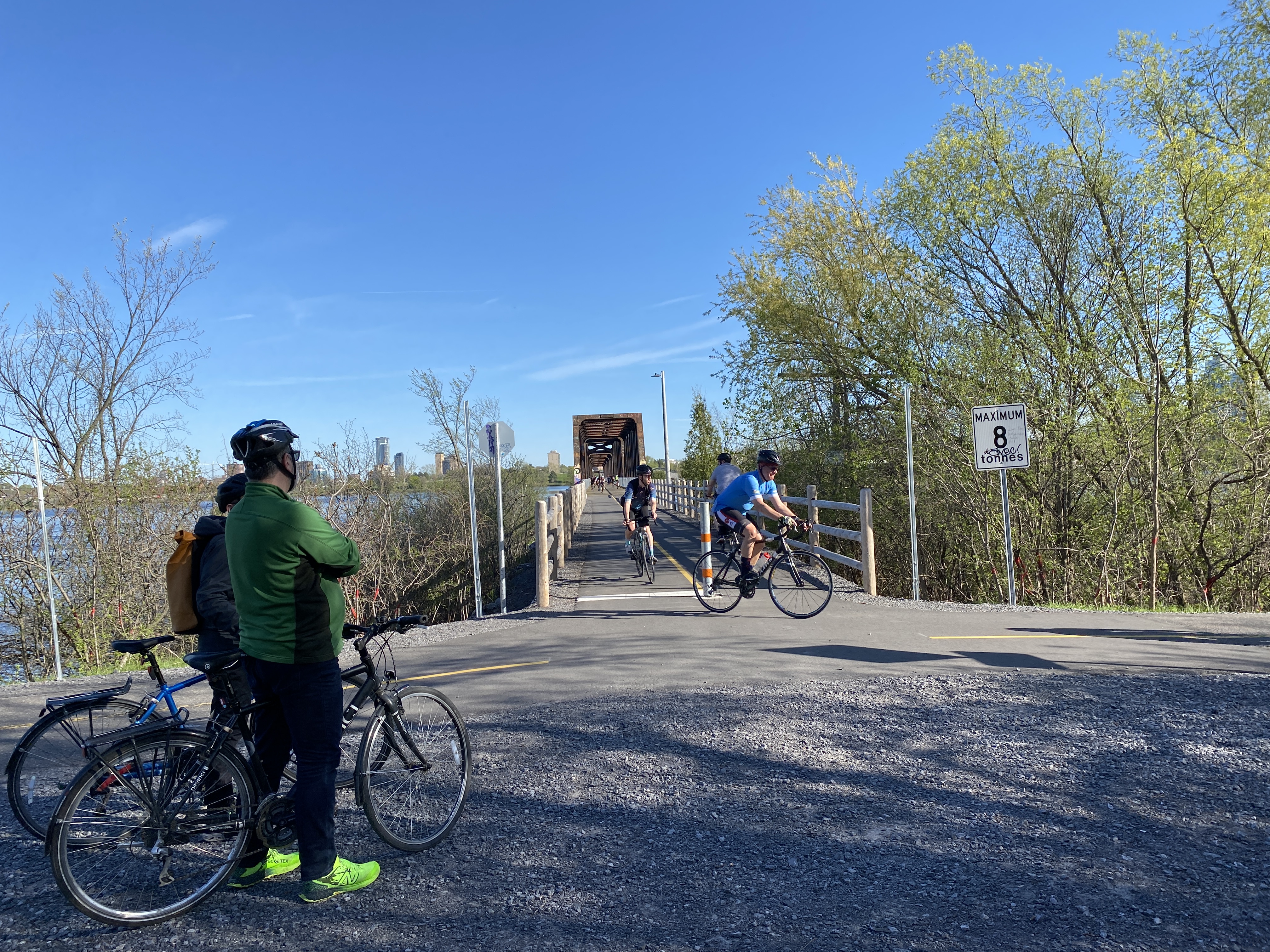
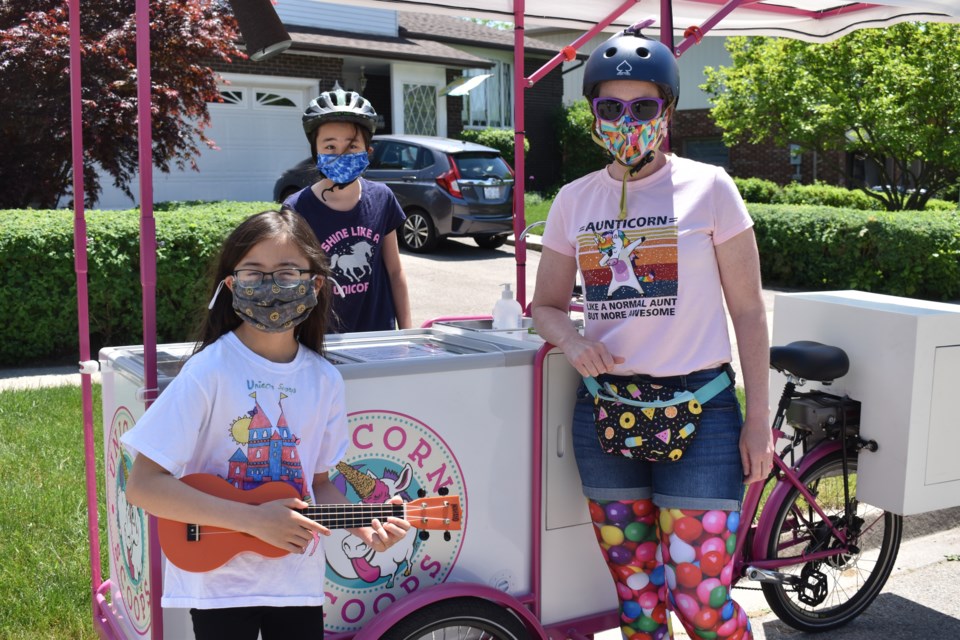
Placemaking: Each end of the bridge now represents key nodes in the regional cycling network, and yet once you’re off the bridge itself (and even when you’re between the two bridges), the feeling as a user is very underwhelming. The grandiose nature of the bridge should be complemented by elegant, open plazas at each end that provide places to rest and encourage people to linger and socialize. Providing a place for cargo bike oriented businesses to sell things like coffee and ice cream (like Guelph’s beloved Unicorn Scoops cargo bike business) would be super cool.
Events: I recently visited Fredericton, New Brunswick and learned that the town has an almost-identical bridge which has also been converted for active uses. The bridge carries up to 2,000 people daily in a community of just 60,000, and what’s incredible is how much the community has worked to activate the bridge. At one end, a brewery has set itself up to be oriented directly to the trail, and in the summer there are regular events on the bridge itself including art displays and Beer on the Bridge. I would love to see some initiative from the governments of the Ottawa region to enable events oriented to the bridge.

The Chief William Commanda Bridge is off to a very strong start, but right now it’s like an amusement park with one ride. Now the City of Ottawa, City of Gatineau, and the NCC must do what anyone should do with a valuable asset – increase its value. With some strategic investments in safety, placemaking, and events, this bridge can become a cherished community asset and a generator of tens of thousands of daily bike trips.

 Beyond the Automobile
I love the idea of cargo bike coffee/ice-cream. NCC Bistro on a bike?
One thought I had last summer was putting a cafe on Lemieux Island.
If you put the cafe in an old boxcar, and some picnic tables on a flatbed car, you could use the old tracks and not even have to do any construction.
LikeLike
Thanks! Lemieux Island is such an untapped resource for public space. Lots of beautiful old trees there too.
LikeLike