
A perennial topic of transportation planning is sharing space. There are many types of sharing that happen:
- Shared-use pathways, featuring pedestrians and small things with wheels
- Shared streets, where small things with wheels and motor vehicles share the roadway
- Bicycle streets, featuring motor vehicles and small things with wheels
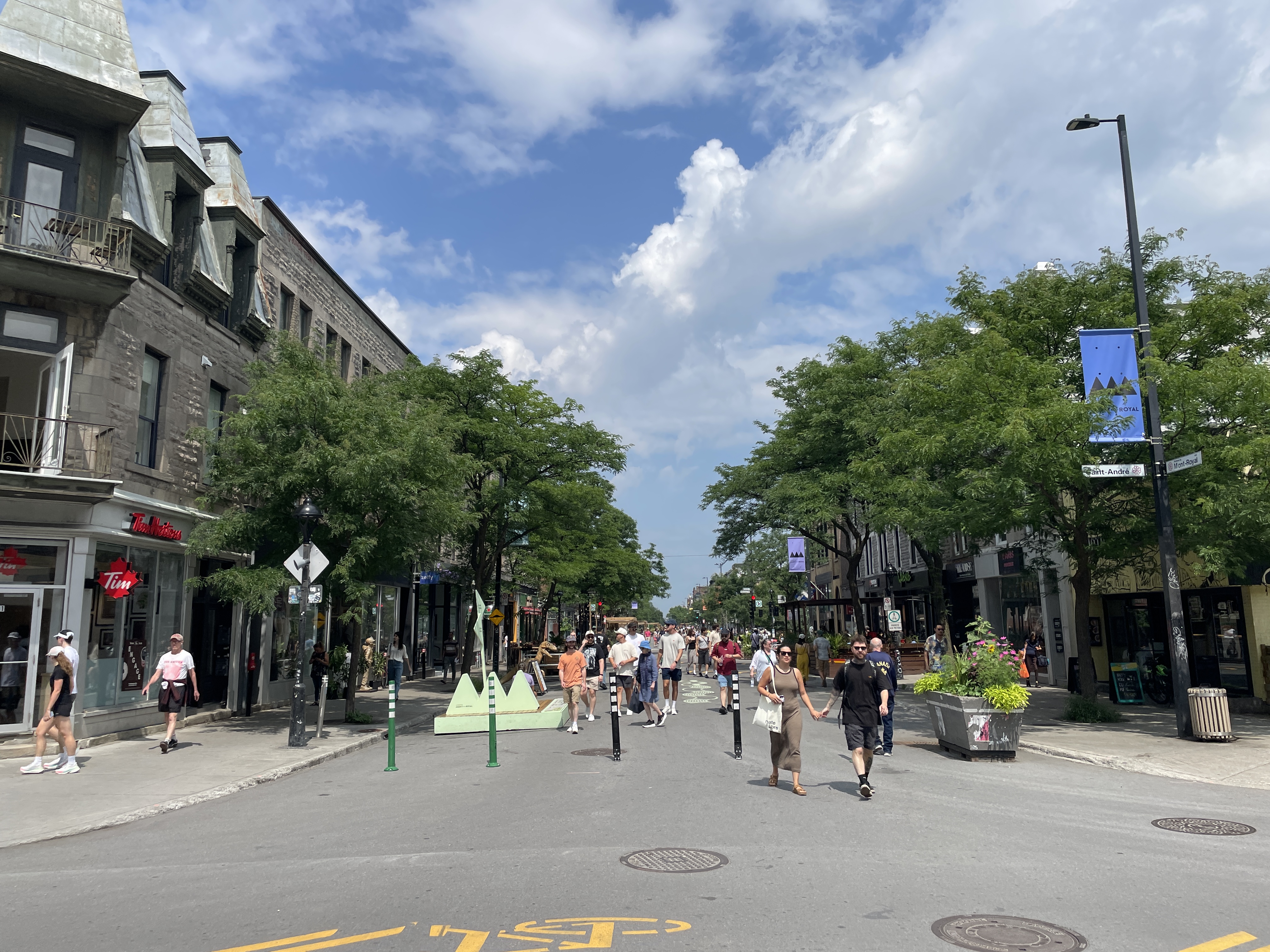
- Pedestrian streets, where motor vehicles are prohibited and pedestrians share space with small things with wheels
- Streets without sidewalks, where pedestrians walk in the roadway with motor vehicles
As a side note, I’m starting to feel like “bicycles” is no longer a sufficient term for capturing all the devices that fit somewhere between pedestrians and motor vehicles. Therefore, for this post I’ve adopted the NACTO term small things with wheels which includes electric and non-electric bicycles, scooters, skateboards, and extra-large bikes. A key trend here is the ongoing electrification of small devices, which has resulted in higher average mass and travel speed of small things with wheels.
Principles of Sharing
As a parent, I’m quite aware that the term “sharing” is generally aiming to achieve equality, and if one child feels that the sharing was not equal, there will be a protest. In street operations, things are fundamentally different because of the vast inequalities of mass and momentum between users. Asking a motor vehicle and a pedestrian to share a street is like asking a toddler to share her snack with an elephant; if we wanted the “human-elephant” split of snack to be equal, we would need about 100 toddlers.
I’m therefore going to assert three principles about shared street spaces:
- In shared street space, sharing is never truly equal – there is always one dominant user group, and everyone else is a “guest” in the space.
- Shared spaces function well when the dominant user group accounts for a high percentage of user volumes, and the “guest” users make up a small minority.
- Artificially changing the natural dominance of one mode takes significant design interventions and may ultimately prove unsuccessful.
Shared-Use Pathways: Who Dominates?
Shared-use pathways (SUPs, synonymous with mixed-use pathways [MUPs]) mix pedestrians with small things with wheels. A quick google search reveals a wealth of complaints about this arrangement from users, usually pedestrians who feel insecure when being passed by cyclists at higher speeds. In contrast, a key study in Vancouver found that SUPs are “moderately comfortable for the average path user” but that a small subset of devices representing 0.8% of users (self-balancing unicycles, electric tricycles, electric skateboards, and sit-down electric scooters) cause most of the comfort issues.
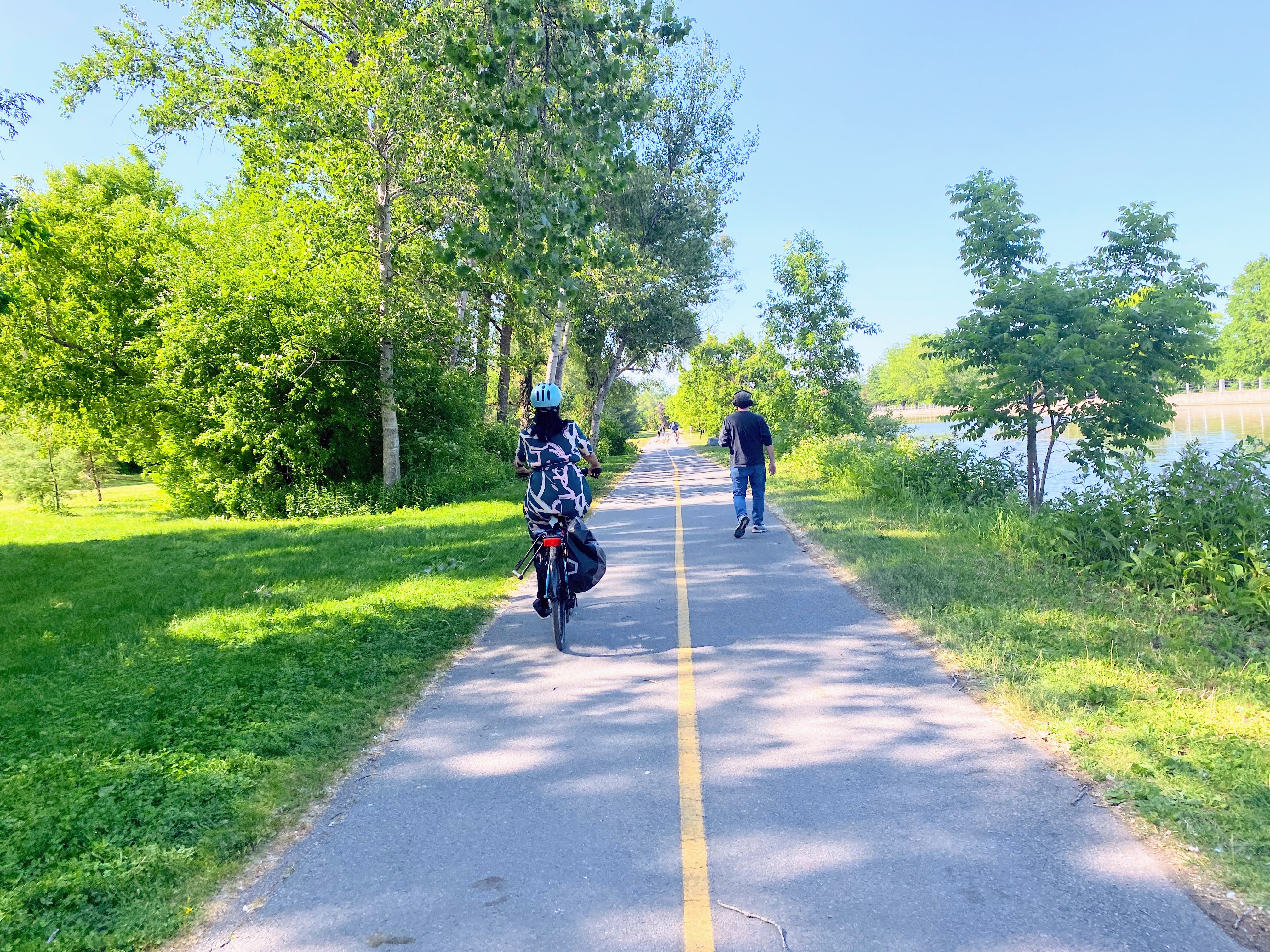
Guidance from TAC (repeated in provincial guidance for Ontario and British Columbia [BC]) advises that when SUP volumes exceed a certain level and pedestrians represent more than 20% of SUP users, the facility should be widened to create separate walking and cycling facilities. Guidelines advise significant caution towards the use of these facilities in built-up areas because of the likelihood of volumes exceeding these thresholds (1,000-2,000 daily users), as well as potential for conflicts at intersections.
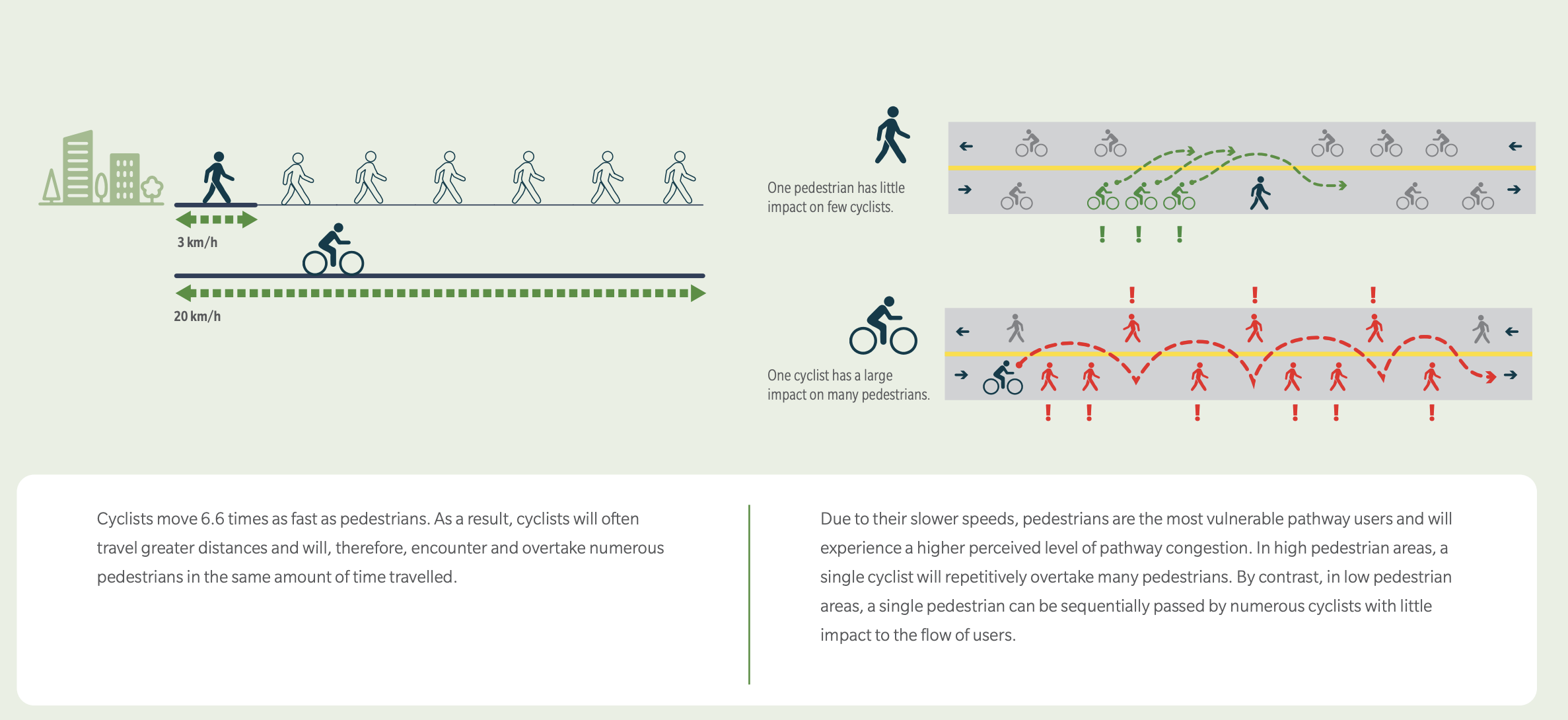
Given that pedestrians are the users who tend to experience comfort issues on SUPs, and that the comfort of SUPs is sensitive to even a small number of pedestrian users, it’s reasonable to conclude that by nature SUPs are a space where small things with wheels dominate, and pedestrians are guests. In a bicycle-dominated space, order breaks down quickly when even a small number of “guests” are present. This is well-explained in this graphic by the National Capital Commission (NCC) that shows how conflicts grow when the volume and ratio of pedestrians increases.
Flawed Application
Based on this logic, there are three common situations where SUPs are applied that are flawed:
- Selecting SUPs for high-volume facilities. With greater user volumes comes greater conflicts, potential for injury, and exclusion of the most vulnerable pedestrians (e.g., children, older adults).
- Selecting SUPs for pathways primarily intended to serve pedestrians (like those traversing major pedestrian destinations such as waterfronts, downtowns, or shopping streets). This will lead to conflicts and pressure to add signage and other mitigation measures to artificially designate pedestrians as the “priority” user. Intuitively, the asphalt design with a yellow line in the middle resembles a “mini-road” and it is not surprising that users of small things with wheels feel compelled to treat it that way.
- Designing SUPs that use pedestrian crossing facilities at intersections. If a SUP is fundamentally for small things with wheels, then bicycle-style crossings should be the primary intersection treatment, or users should be split at intersections with separate walking and cycling crossings. Designing SUPs with crosswalks invites users to violate the law and creates misaligned expectations for drivers.
Both of these criticisms are tough to hear for planners and designers because solving them requires both a change in practice (i.e., adopting protected intersections as a default treatment for SUP crossings) and generally more money and space. I’m not against using SUPs on lower-volume facilities, but if they are in a location where volumes will likely grow over time, the SUP should be seen only as an “interim” treatment, with the ultimate condition being a separation of users. Just like we plan roadways with room for future widening, the same should be done for SUPs.
Solutions
Shared-use pathways are places where small things with wheels are the dominant user and pedestrians are guests. What should be done to help these operate safely and comfortably for all users? Here are the three most effective measures:
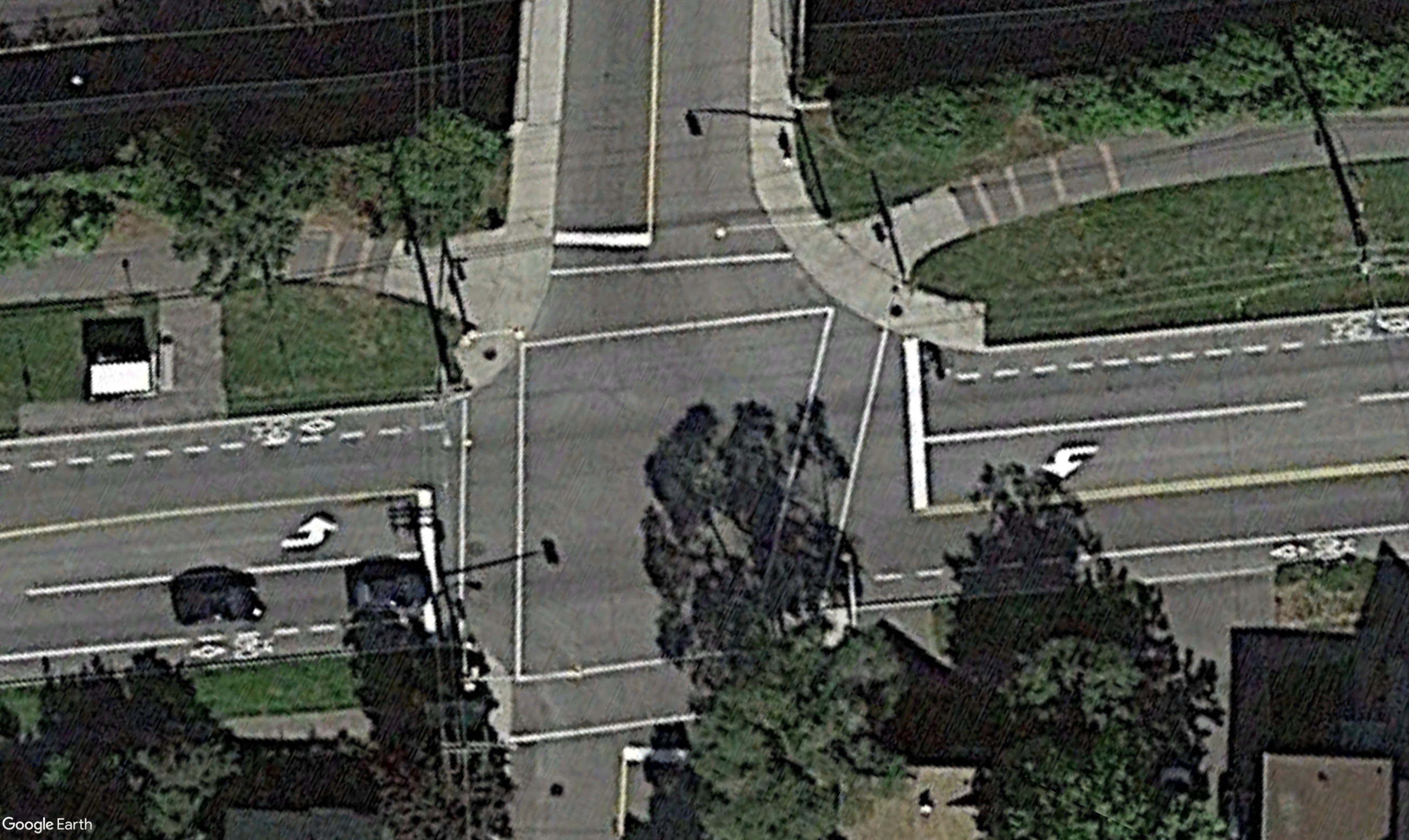
Solution #1: Standardize the use of protected intersections with SUPs. Separating users at intersections helps simplify expectations for all users and allows the dominant user to cross legally without dismounting. The image below from Ottawa shows an SUP intersection that was upgraded to provide separate crossings.
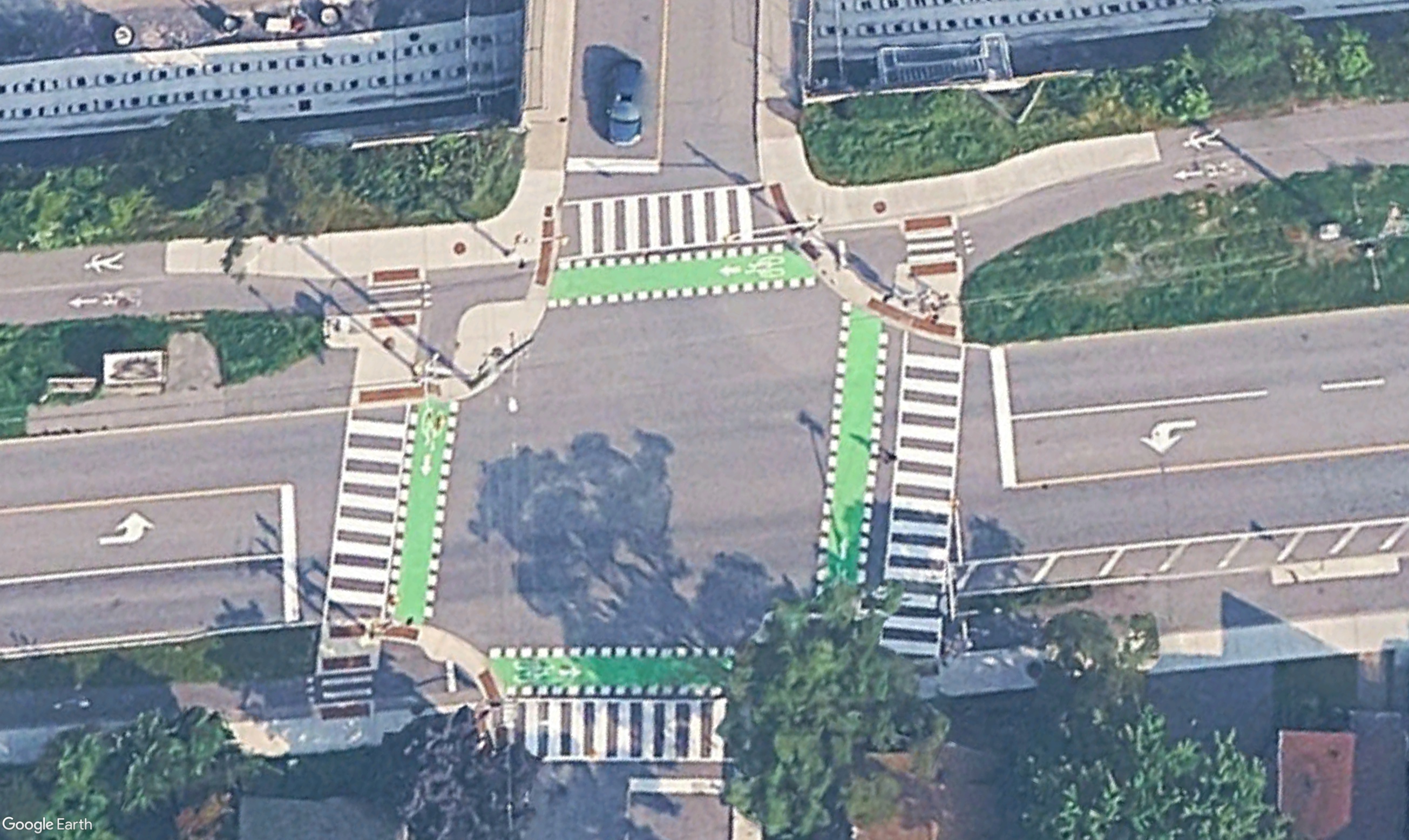
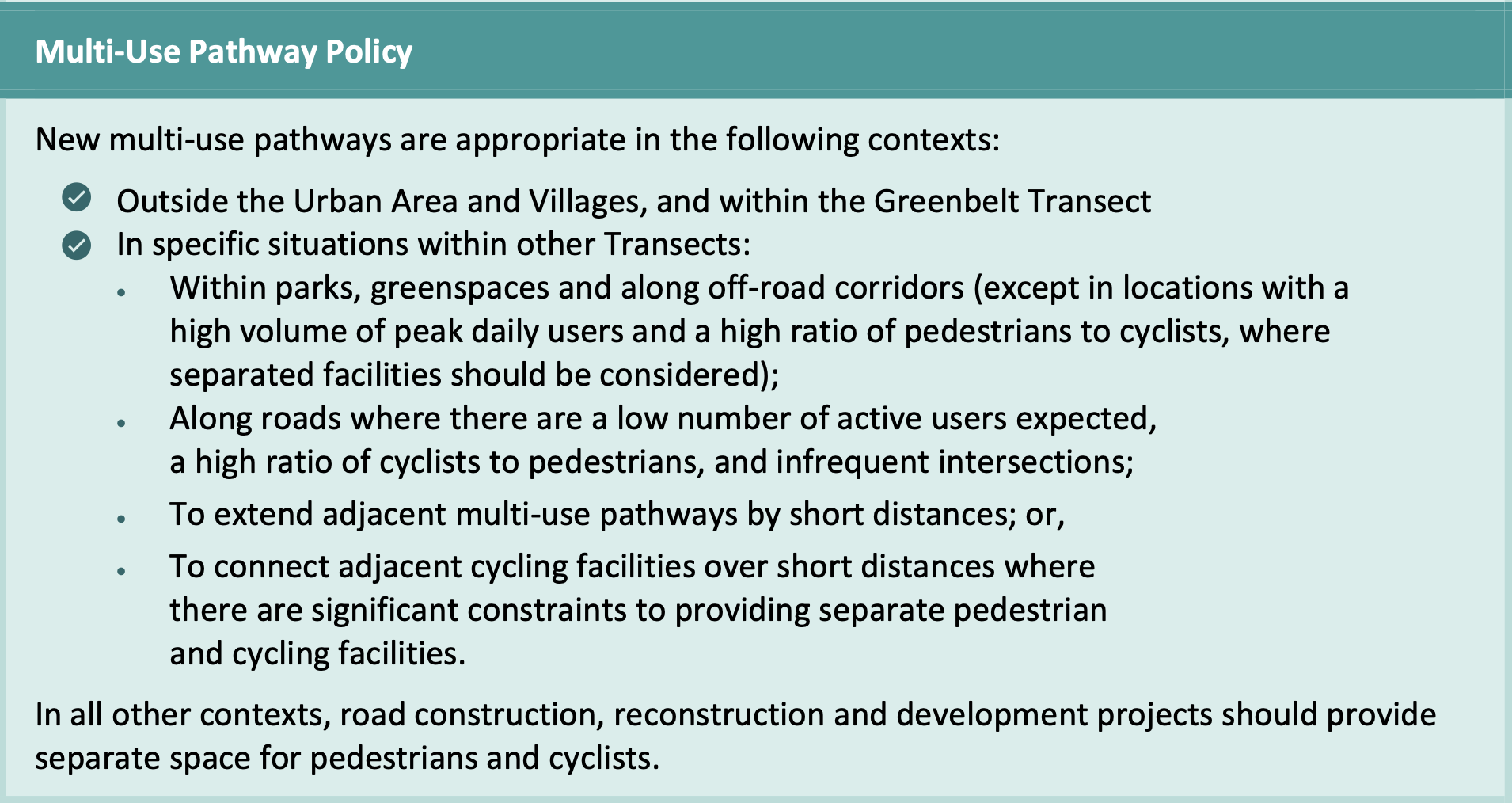
Solution #2: Develop a policy on where SUPs should and should not be used. The City of Ottawa’s policy on this (see below) is excellent and should be a model for other communities.
Solution #3: Focus enforcement, regulatory, and education efforts on the <1% of SUP users that are the worst offenders: self-balancing unicycles, electric tricycles, electric skateboards, and sit-down electric scooters. These devices are largely unregulated and capable of travelling at very high speeds.
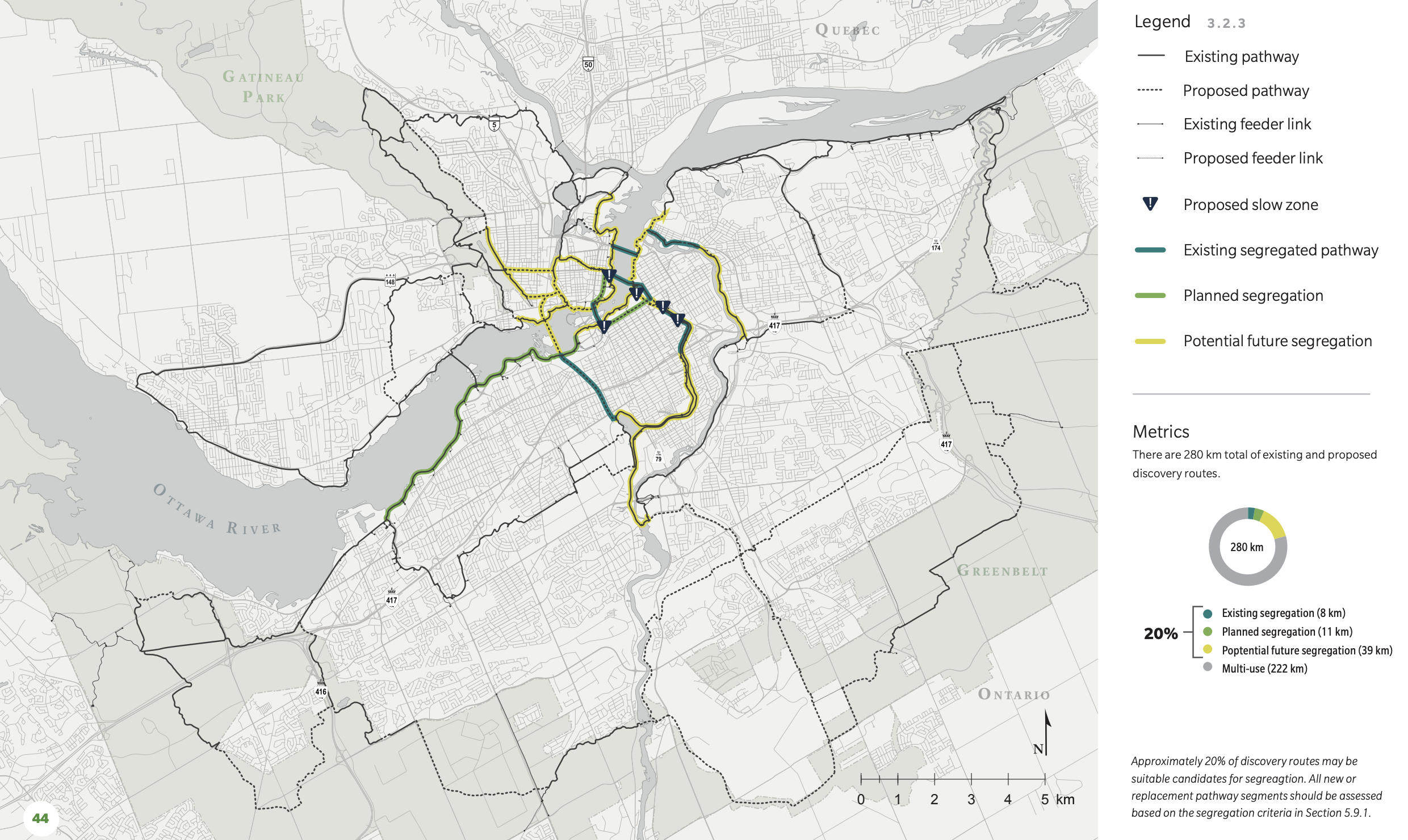
Solution #4: Develop plans to upgrade moderate- and high-volume SUPs to separate facilities over time. Segregation can be prioritized in the busiest segments and areas to maximize value of investment. The NCC’s Capital Pathways Strategic Plan (p44) identifies which existing trails are planned for segregation as well as candidates for “potential future segregation”.
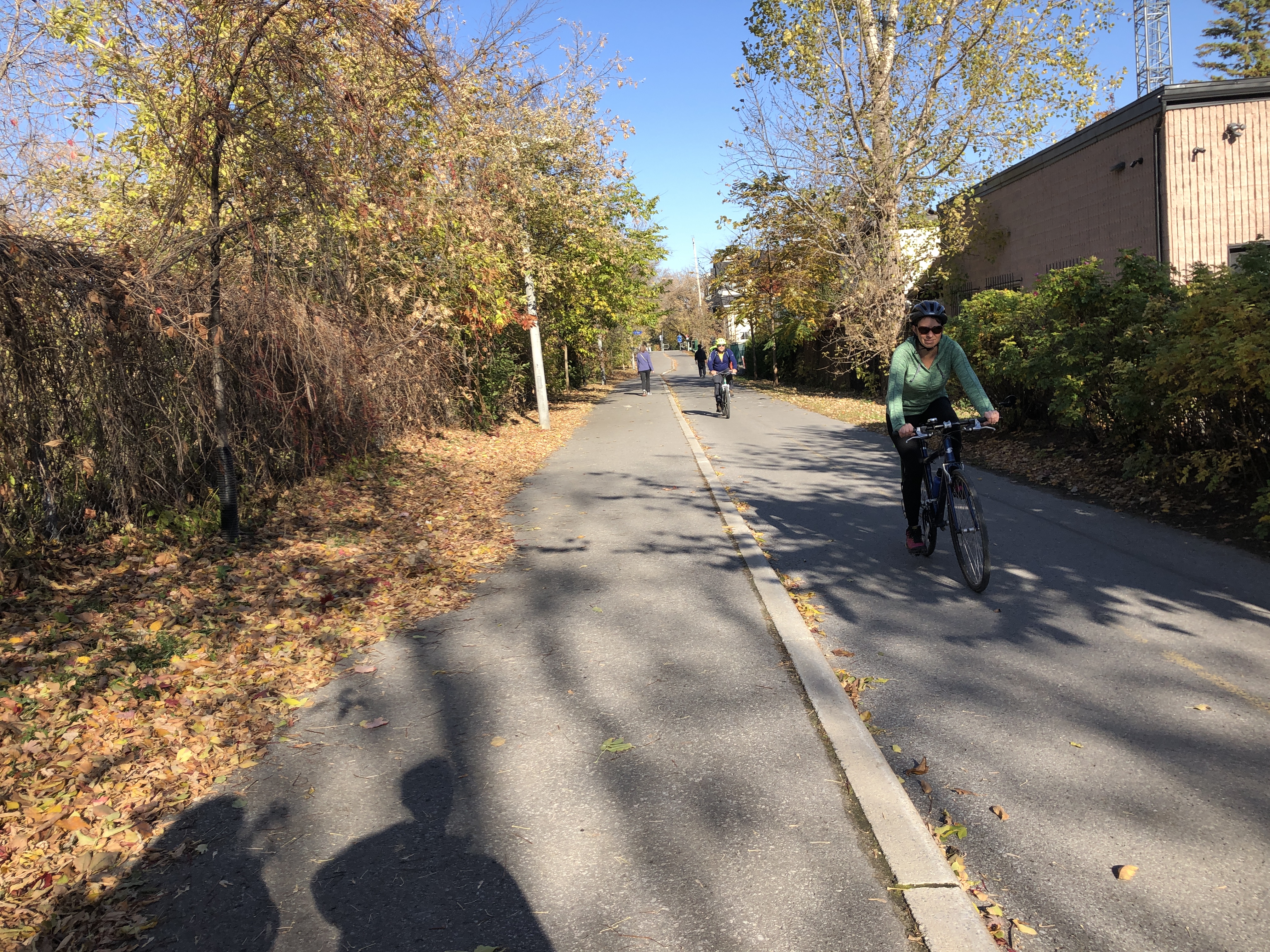
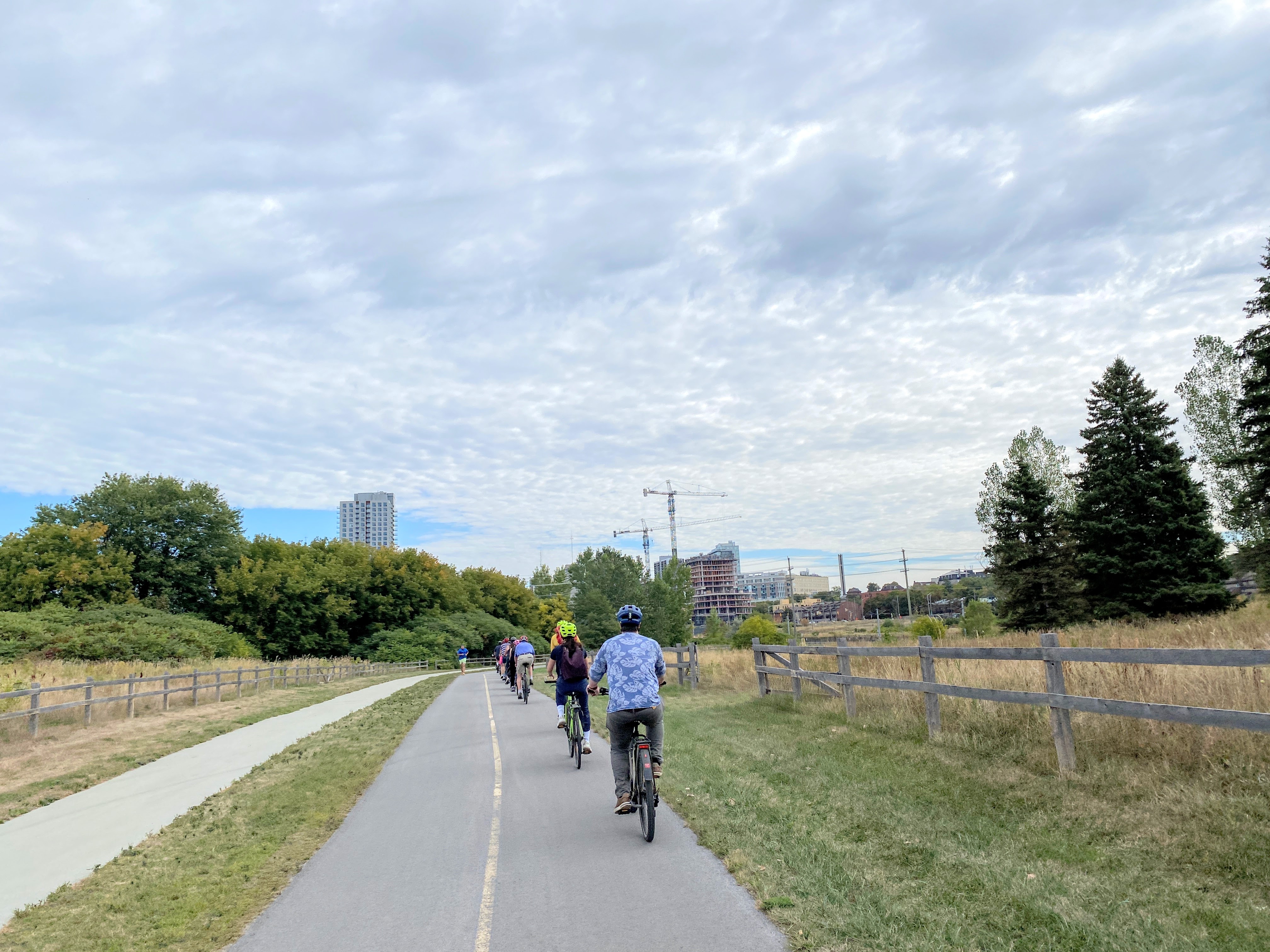
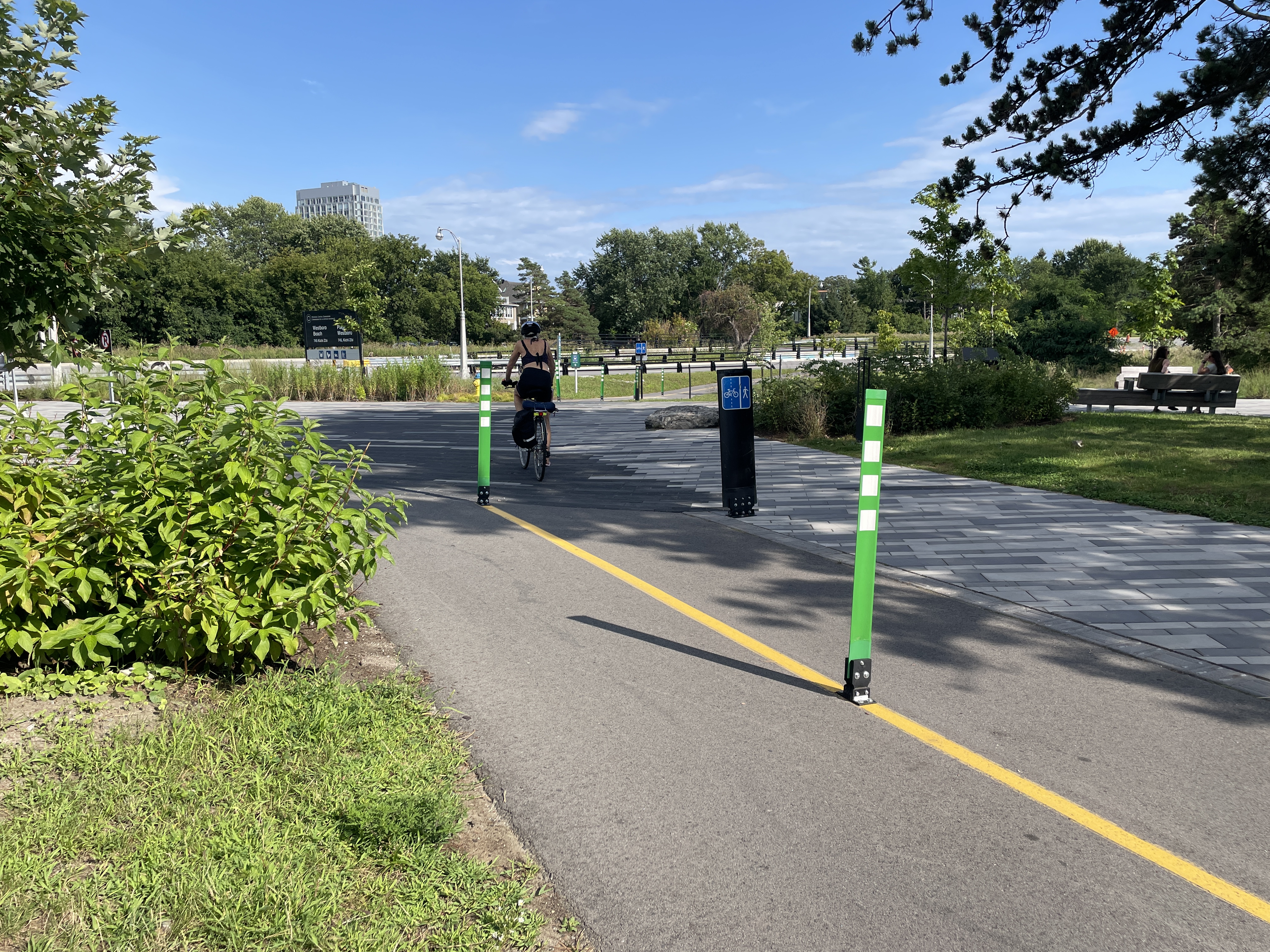
Three examples in Ottawa of separate facilities for pedestrians and small things with wheels.
Conclusions
Ultimately, SUPs are a useful interim treatment in lower-activity areas. At SUP crossings of roadways, we should be building crossings that allow cyclists to cross legally, we should have clear policies on where SUPs are a useful treatment (and where they should be avoided), and planners should work on upgrading SUPs to separate facilities over time.
At the start of the post I shared three principles of shared spaces: (1) there is always a dominant user group, (2) shared spaces function best when non-dominant users (guests) make up a small minority of users, and (3) trying to reassign the natural hierarchy is very difficult. Shared use pathways (SUPs) exemplify these principles quite well, and thinking about them this way can help practitioners to avoid using them in the wrong places.
If you have thoughts on what type of “shared space” you’d like me to discuss next, please share it in the comments.


I live in Brampton, which has been rolling out shared-use pathways for a few years now. I don’t think a lot of people understand the separate bicycle/pedestrian crossings that most signallized intersections have. I often see people using the bicycle crossing or cyclists using the crosswalk.
I think the problem is that the concrete sidewalk just starts at the side of the asphalt path right before the intersection, with little indication that pedestrians are supposed to move onto the concrete. There aren’t even any TWSIs guiding pedestrians onto the sidewalk like the OTM recommends. Or in some other cases, the concrete area for pedestrians appears as just a blob at the corner of the intersection, with the asphalt bike path surrounding it.
It’s also not uncommon for people to mix up the push-buttons for pedestrians and cyclists. The problem is that bike buttons in Brampton look just like pedestrian buttons, with a slightly different sign.
LikeLike
Great post! I’ve been wondering for a while while we don’t have more SUP’s replacing sidewalks in Ottawa – the most recent being Hunt Club Road from Cahill going east. Why do we rebuild concrete sidewalks that are juuuuust slightly too narrow to be used as a SUP? It’s not a high traffic area for pedestrians, and could be a great space for cyclists – particularly because there is a painted bike lane on the road, so taking a foot or two out of that lane to make the SUP wide enough should in theory be fine and not actually have any impact on car lanes.
LikeLike
My recent experience showed that narrow sidewalks complicate those pathways significantly. This difference between theory and reality needs more attention.
LikeLike
Hi Matt. This is a great summary of the issue and I agree with all of your points and recommendations. Growing the bicycle modal share requires creating more space for cyclists where appropriate (many many locations in Ottawa) and reducing pedestrian/cyclist conflict on off-road facilities. Just wanted to note that the pathway etiquette/code of conduct signs on both city and NCC pathways have been of great value in reducing conflicts and improving behaviours but only works until user volumes get too high. And we want them to increase, a lot! Thanks! Robin
LikeLiked by 1 person
Thanks for sharing Robin! Nice to hear from you. And great point about education being a useful measure when volumes are moderate.
LikeLike