
Traffic is the topic of all time that keeps coming back, and our decision makers are often most focused on the major roads that carry the most traffic. But while major arterials make up the backbone of our traffic network, our local streets actually comprise most of our network, and tend to be the places that matter the most to people as “places”.
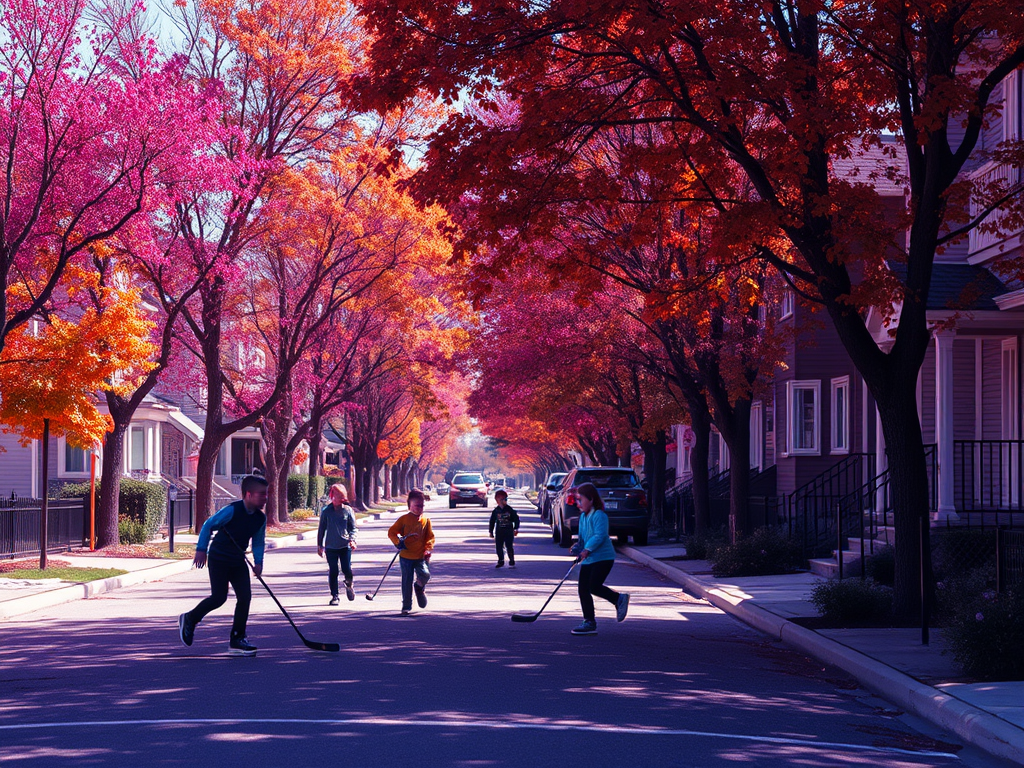
A lot of great things can happen on a local street: kids can play, neighbours greet each other, dogs get walked, even street parties can happen. A great local street feels like a part of the neighbourhood, with car traffic being just a background function.
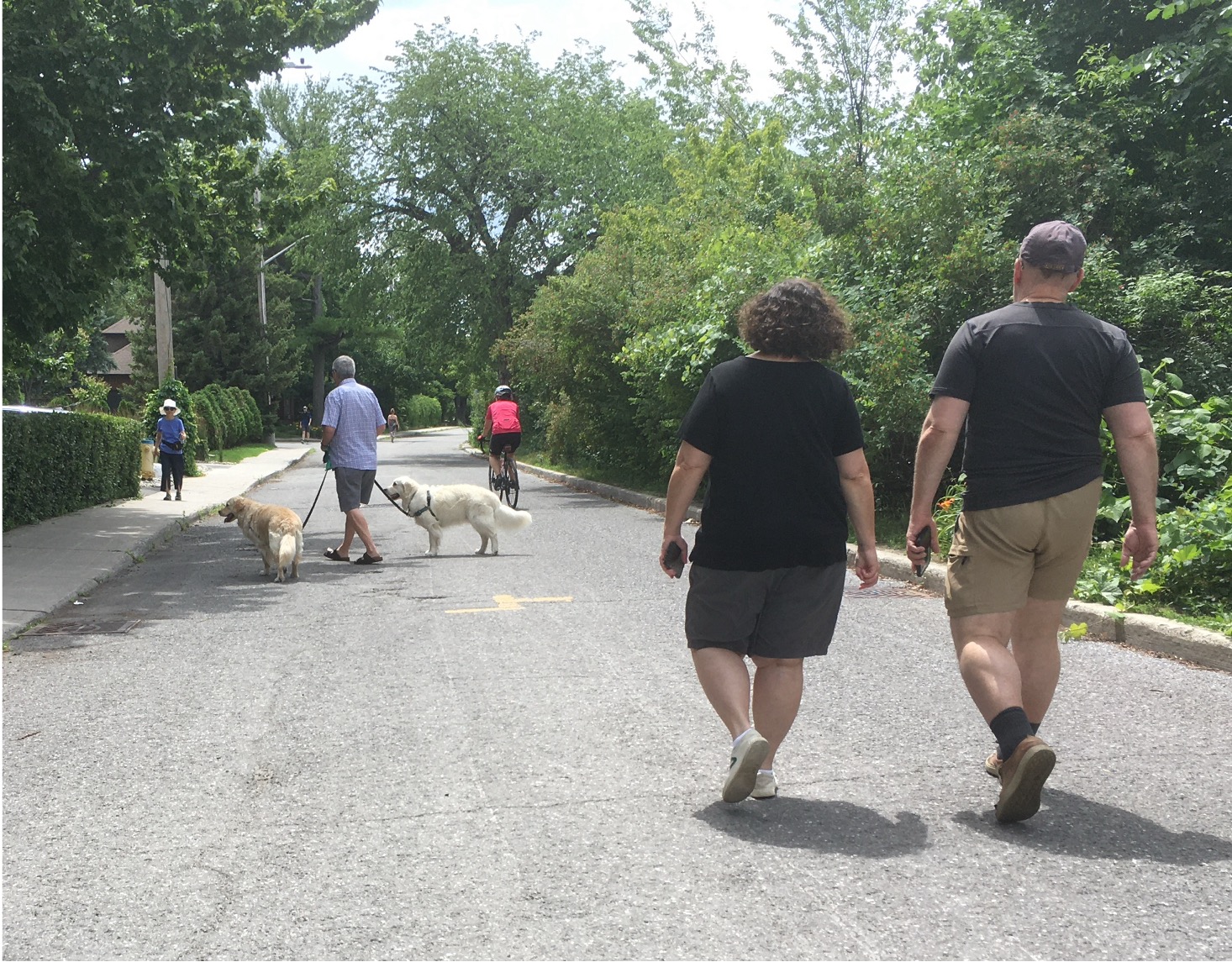
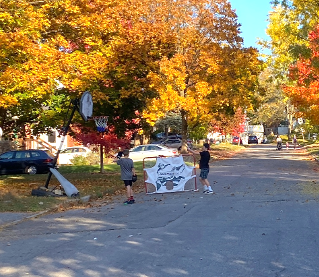
Two ultra-low traffic streets in Ottawa, each carrying < 500 cars a day.
Sadly though, when local streets are designed poorly, that “place” value erodes quickly. As vehicle speeds and volumes increase, people become less interested in being anywhere near the street, and those social moments happen in private spaces instead.
How much traffic should a local street carry?
We often label streets as “local” without that actually means for liveability. Consider these volume thresholds for local streets:
- All-Ages-and-Abilities Neighbourhood Bikeway:The recommended traffic volume for the best experience for people using a local street as a bike route is less than 500 vehicles per day.
- Typical local street: Canada’s national street design guidance (TAC) recommends that streets be considered local when they carry less than 1,000 cars daily.
- City of Toronto local street: In Canada’s biggest city, where traffic seems to fill up every street it can find, the upper limit for a local street is 2,500 vehicles per day.
How much is too much? Interestingly, in Owen Sound, a local street qualifies for traffic calming once it hits 3,000 vpd, regardless of speed. Yet, I’ve seen traffic engineers create traffic models for new communities assuming that a “local” street can handle up to 4,000 vpd. This gap in definition is where liveability is often lost.
What if we prioritized liveability on local streets?
Rather than simply serving as the last few hundred metres of someone’s car trip, we need to think bigger about local streets – especially in urban areas and town centres where people are often willing to trade less private space for having more public space, but also in suburban residential areas.
Let’s put these volumes into perspective. 2,500 cars per day is roughly 250 cars in the busiest times, or 4 cars per minute, while 500 cars a day is less than one per minute at the busiest time (and probably one car every 5 minutes at other times). For any type of street-based play to happen, volumes need to be very low. Consider the age-old Canadian tradition of playing hockey in the street. I remember this as a kid, yelling “CAR!” when we see someone coming and moving the nets off the road momentarily. For street hockey to really be possible, you shouldn’t have to move the nets more than once every 5 minutes.
I take inspiration from the Town of Canmore, Alberta, which for over a decade has been taking advice from the Dutch and has grown in a much more sustainable way as a result. Canmore’s 2014 transportation plan assigned maximum traffic volumes to different types of local streets based on their objectives:
- Typical paved residential street: max 2,000 cars/day
- Local street in the bike network: max 1,000 cars/day
- Pedestrian priority local street: max 500 cars/day
Instead of treating all local streets equally, Canmore picked certain ones that matter more for community functions, and committed to treating them differently. If a local street that’s part of the bike network is carrying more than 1,000 cars a day, the Town has reason to make changes like adding traffic diverters to get those volumes down.
Ultra-low traffic spaces
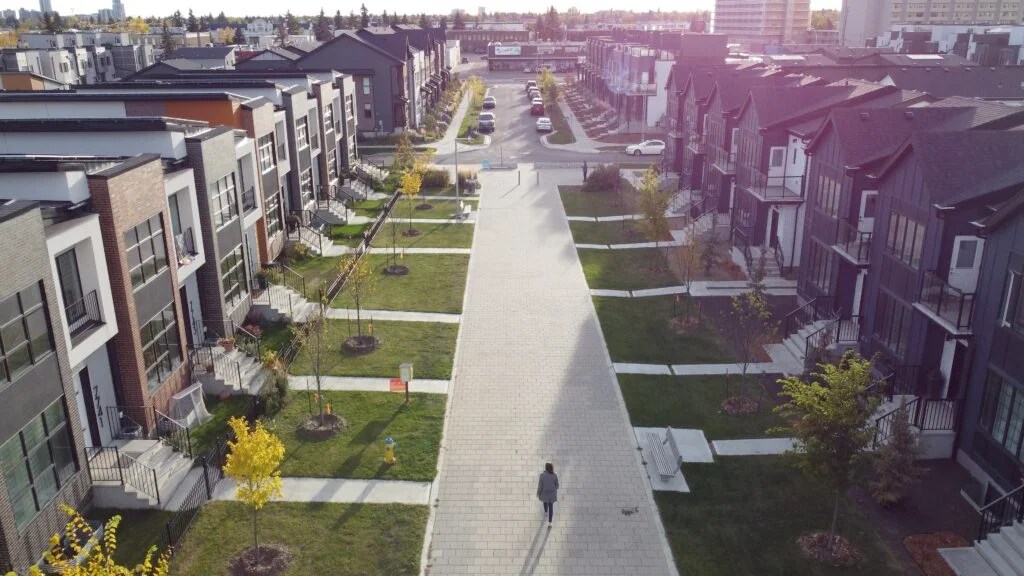
My final example to share is from the City of Edmonton, in its master-planned Blatchford development. The first phase of its development is mostly townhomes, which in a typical development would be served by the same local street design repeated over and over. In Blatchford, they picked one local street and chose to do something special with it: for one block, York Road becomes York Mews, a street where cars are prohibited, with a brick surface instead of asphalt. Though I visited midday on a weekday in November, I was told by a resident that this street quickly became the place where kids gather to play after school and on weekends. Why not a park? The kids find it easier to run inside and get toys for games, and the parents like that they can watch from inside while making dinner.
Recommendations for local streets:
Most of your older relatives probably played in the street when they were kids. But with the growth of the car and the mindset that all streets should be designed as “roads”, we’ve almost engineered street play out of our streets (except for places like cul-de-sacs, which people love for exactly this reason). By thinking more consciously about this important function of local streets, we can make the necessary changes to bring it back.
- Don’t treat all local streets as equal. Allow certain ones to be more “special”, whether it’s for active transportation or for places community activities and street play can happen.
- For all local streets, take traffic volumes more seriously. Most should not carry any more than 500 cars a day. Some should carry even less. If a local street is carrying more than 1,000 cars a day, have a serious conversation about what could be done to bring volumes down.
- All local streets should be designed for 30 km/h – the speed at which someone is unlikely to be killed or seriously injured in the event of a collision.
- A local street should never be modelled as part of the car network. As soon as we start assigning traffic capacity to these streets, we’ve lost the plot on what they are truly for.


Great post, very relevant to my outer-urban bungalow-belt neighbourhood in Ottawa.
Hope we a bike-friendly mayor wins in the upcoming election, NOT Mark Sutcliffe, hopefully either Jeff Leiper or Neil Saravanamuttoo. Hope they don’t split the vote.
LikeLike
The York Mews as you mentioned is not a 500 cars/day design. It’s a 0 cars/day design. I can’t agree to call it “Ultra-low traffic space”. It should be called ZERO traffic space instead.
Don’t imagine those activities at York Mews will be observed on a 500 cars/day street as well. From personal experience, on a 500 cars/day street, you can find people crossing at whereever they wish occasionally, but It’s still not safe enough for children to play at.
If your target is safe for children, you should design the space as 0 car/day, not 100 car/day or even more.
LikeLike
Thanks for sharing, I tend to agree. I have seen some ultra low car streets that work for kids to play but not necessarily gather in large numbers.
LikeLike